 Hyperfoundation
Hyperfoundation HYPE staking compounds rewards through validator delegation
Hyperfoundation HYPE staking uses Hyperliquid’s native delegation system in HyperCore to earn automatically compounded HYPE rewards. Delegators assign stake to validators that participate in the network’s consensus. Rewards accrue every minute and are distributed daily, increasing the delegated balance through automatic redelegation. Access to HYPE follows separate timing rules: delegation has a one-day lockup, and moving undelegated HYPE back to spot starts a seven-day withdrawal queue. Compounding grows the staking position without making those tokens immediately available for trading.
In this guide
Delegations connect HYPE balances to validator rewards
Native staking connects a token holder’s delegation to an active validator that produces blocks and contributes to the network’s agreed transaction history.
Spot and staking balances
HYPE enters native staking from the HyperCore spot balance. Transferring it into the staking account makes it available for delegation. A deposit and a delegation perform different operations: the deposit moves HYPE between account balances, while delegation assigns an amount to a validator. Merely holding an undelegated staking balance does not create a reward-earning validator allocation.
Validator stake and commission
The validator operates the infrastructure that participates in consensus; the delegator contributes HYPE stake. Commission is the portion of staking rewards that the validator retains before the protocol distributes the remainder in proportion to eligible delegated balances. That commission affects the delegator’s reward credit, so a network reward rate and a validator’s net payout describe different quantities.
Reward credits compound on the delegated balance
Automatic compounding reinvests distributed HYPE within native staking. The protocol automatically redelegates distributed rewards to the validator that earned them. The credited tokens join that delegation, giving subsequent rewards a larger potential earning balance.
Accrual, distribution, and epochs
Minute-by-minute accrual measures rewards accumulating between distributions. Daily distribution adds the credited HYPE to delegated stake. Reward eligibility follows the minimum balance that a delegator held staked during each epoch, so an increase late in an epoch does not retroactively increase its minimum eligible balance.
Each staking epoch covers 100 000 consensus rounds. Daily reward distribution and the epoch’s balance calculation therefore describe different accounting intervals.
Reward rate and token value
The reward rate follows an inverse-square-root relationship with total HYPE staked across the network. Increasing total stake lowers that rate under the formula. Rewards come from the future emissions reserve. Validator commission then affects the amount that reaches the delegator, while validator eligibility determines whether reward production continues.
An annualized HYPE reward rate measures token growth. HYPE’s market price determines the cash value of those tokens, including compounded rewards. A larger token balance can therefore coexist with a lower market value. Projecting a fixed annual payout would require assumptions about future rates, validator participation, and price.
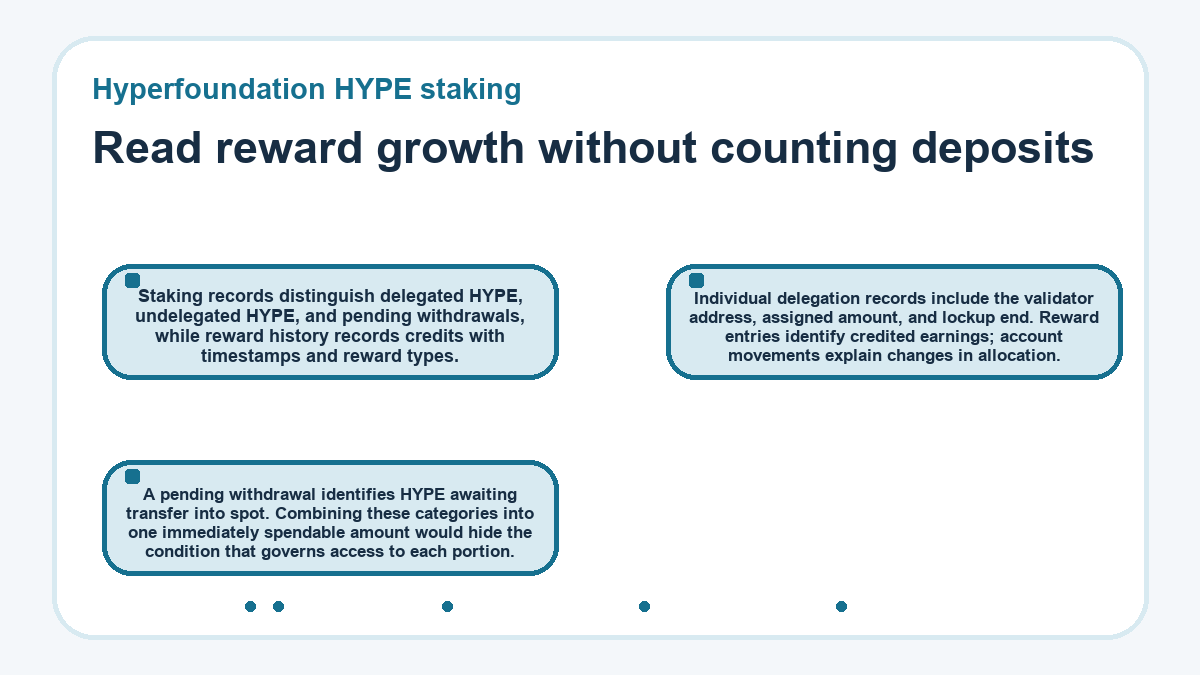
Read reward growth without counting deposits
Staking records distinguish delegated HYPE, undelegated HYPE, and pending withdrawals, while reward history records credits with timestamps and reward types.
Individual delegation records include the validator address, assigned amount, and lockup end. Reward entries identify credited earnings; account movements explain changes in allocation. A pending withdrawal identifies HYPE awaiting transfer into spot. Combining these categories into one immediately spendable amount would hide the condition that governs access to each portion.
A hypothetical balance with different uses
Consider a hypothetical staking account containing 173 HYPE: 123 HYPE delegated to an active validator and 50 HYPE undelegated. Assume the delegation stays unchanged throughout an eligible epoch, with no other account movements. Let R represent a hypothetical net reward credit. Why do the delegated and undelegated portions have different uses?
The 123 HYPE contributes to the validator’s delegated stake and supplies the eligible balance for this case. The separate 50 HYPE remains available for another delegation or a staking-to-spot withdrawal request. Holding that undelegated portion does not increase the existing validator allocation’s reward basis.
After distribution, automatic compounding makes the delegation 123 + R HYPE. The undelegated portion remains 50 HYPE, and the combined balance becomes 173 + R HYPE. The reward credit increases stake backing the validator; it does not convert either portion into a completed spot transfer. This calculation assumes the validator remains eligible to earn rewards.
When does undelegated HYPE return to the spot balance?
On Hyperliquid mainnet, HYPE returns to spot after a staking-to-spot transfer completes its seven-day queue; releasing a validator delegation alone leaves it in staking.
Release the validator delegation
A delegation’s one-day lockup restricts when its HYPE can be undelegated. After that period, the delegator can release part or all of the delegation. The released amount immediately appears in the undelegated staking balance. A remaining delegated portion continues to have its own reward eligibility.
Undelegated HYPE can remain in staking for redelegation. It does not automatically start a withdrawal.
Queue the staking-to-spot transfer
The seven-day withdrawal period starts when the staking-to-spot transfer is initiated. The account’s pending-withdrawal amount tracks tokens awaiting that transfer. The delegation lockup and withdrawal queue apply to different operations, so the one-day period does not replace or shorten the seven-day period.
After the queue completes, the transferred HYPE appears in the spot balance. An undelegation record or pending request establishes an earlier state. Neither establishes that the tokens have already reached spot, even when the account still shows ownership of the HYPE.
Validator jailing interrupts reward production
Jailing suspends a validator’s block voting and proposing when participation fails the network’s performance rules. A jailed validator produces no staking rewards for its delegators. Other validators can vote to jail a peer whose responses to their consensus messages are too slow or infrequent. Jailing requires votes representing more than two-thirds of the network’s stake.
The operator must address the cause and unjail the validator within the protocol’s limits before restoring participation. Jailing concerns validator participation and differs from slashing for provably malicious behavior. Native staking currently has no automatic slashing. The absence of that mechanism does not prevent missed rewards during jailing or changes in HYPE’s market value.
Native rewards, fee discounts, and liquid-staking receipts
Native delegation grows a HYPE staking balance through reward credits. Trading discounts reduce eligible trading charges under separate fee rules. Liquid-staking services can issue a receipt token representing underlying staked HYPE and use their own contracts and redemption mechanisms. A receipt’s trading availability or redemption terms come from that service; automatic native compounding alone does not establish those additional capabilities or immediate access to the underlying HYPE.
Hyperfoundation HYPE staking - your questions answered
Must HYPE delegators meet the validator self-stake requirement?
The 10 000 HYPE self-delegation requirement applies to activating a validator. That required self-stake has a one-year lockup. Delegating HYPE to an existing validator is a different participation role. The operator’s activation requirement should not be interpreted as the amount that every ordinary delegator must supply.
Can a staking account delegate HYPE to multiple validators?
A HyperCore staking account can delegate HYPE to multiple validators. Each allocation belongs to its selected validator and follows the applicable delegation lockup. Allocations can encounter different commissions and performance outcomes. Splitting stake changes where it contributes to consensus; it does not establish a higher reward rate or remove the staking-to-spot withdrawal queue.
Does HYPE held on HyperEVM earn native staking rewards automatically?
Holding HYPE on HyperEVM does not automatically create a native validator delegation. Native staking uses the HyperCore staking account. HYPE starting on HyperEVM must first move into the HyperCore spot balance before entering that staking account and a validator delegation. Ownership of the same token across these balances does not give each balance the same reward eligibility.
What happens when a staking address has five pending withdrawals?
An address can have at most five withdrawals pending in the native unstaking queue. With all five slots occupied, another withdrawal cannot join the queue until capacity becomes available. This limit counts pending requests, not validators or HYPE tokens. The account’s staking summary reports both the pending amount and the number of pending withdrawals.
Is there a faster way to complete the native unstaking queue?
The native staking-to-spot transfer cannot be accelerated below its seven-day queue. Undelegating earlier does not shorten that transfer period. Trading a liquid-staking receipt, where a service supports it, is a separate transaction involving that receipt and available liquidity; it does not speed up the underlying native withdrawal.
When is staking-wallet linking relevant to trading discounts?
Linking can attribute a staking address’s staked HYPE to another address’s trading fees when both belong to the same user. One address handling both activities needs no link. Linking is permanent, and the staking address loses its own staking-related fee discount. The staking address can irreversibly disable the linked trading address and lock all of the trading address’s funds. Those funds automatically transfer to the staking address one year after locking.
Are foundation delegation-program applications required for ordinary HYPE staking?
Foundation delegation-program applications concern validator operators seeking foundation backing. Applicants face identity checks and node-operating requirements. A token holder participates in ordinary native staking by delegating HYPE to an existing validator. Program approval governs the foundation’s support for an operator; the protocol governs rewards on an individual’s delegation.
Which reward-history entries represent validator commission?
Reward-history entries marked commission represent the validator’s commission income, while entries marked delegation represent delegation rewards. The history also records each entry’s time and amount. These categories distinguish operating a validator from contributing delegated stake, so a validator’s commission income should not be presented as the ordinary delegator’s reward rate.
Updated: